texts
2026-07-03
‘A difficult and intricate history’ workshop, University of Auckland, 25-26 June 2026
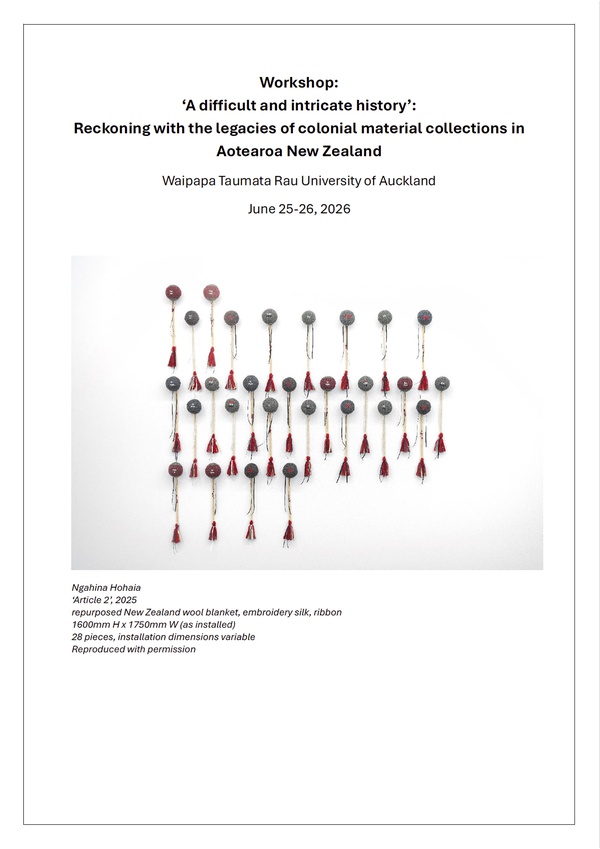
A privilege to present the meandering early context and anatomy of the book and exhibition ‘A Vocabulary’, a vocabulary of colonisation, at the workshop, ‘A difficult and intricate history’, co-convened by Dr Rowan Light, project curator for the New Zealand Wars, Auckland War Memorial Museum.
kia ora everyone, tēnā koutou kātoa.
And, tēnā koe, Rowan, for pulling me in to this workshop of celebrated citizens, an independent maker who works aside from the academic sphere.
I am Pākehā, of Huguenot descent, London settler-colonial stock, fourth/fifth generation.
I’ll speak about the early context and the anatomy of ‘A Vocabulary’, my book and exhibition project, a vocabulary of colonisation, with a slideshow / sideshow of the book. A thread only in a greater cloth.
*********
You know, there’s a plaque on the outside front wall of Ivybridge House, 1 John Adam Street, London WC2, a block or two from the Savoy Hotel, celebrating, or commemorating, I’m unsure which, the despatch of the TORY ‘to begin the colonisation of New Zealand on the Wakefield Plan’. It was positioned in 1974 by the New Zealand Historic Places Trust, and unveiled in 1975, on an official visit to London, by Aotearoa New Zealand Labour Prime Minister, Bill Rowling.
*********
It seems, when I sometimes peep back at my meandering photography oeuvre, the consequences of British colonisation have been — although not with clear calculation — a significant part of a long enquiry, of which ‘A Vocabulary’ is the latest outcome. That plaque is in the book.
My first unrecognised encounter with these consequences came, in my early 20s, in the early 1970s, while passing through Roebourne with my then wife, on a circumnavigation of Australia. It was, and still is, a rural, north-west Australian town in the Bilybara Pilbara region, 1,500 kilometres up from Boorloo Perth, a white service town with a small, disconsolate Aboriginal population. We were there one troubling night.
In the context of colonisation, Aotearoa New Zealand hadn’t registered through my childhood or even my early teens, although through sharp teachers at intermediate and secondary school (Dee Twiss and Jeny Curnow respectively), I learnt of the Sharpeville massacre and the Mau Mau Rebellion. Surely, neither was in the curriculum. That teaching stayed with me. I did not learn about our colonial wars.
Our household subscribed to the international edition of LIFE magazine rather than the New Zealand Listener magazine, so the US/Vietnam War implanted deeply, as did the US as a demented power, in spite of the magazine’s not-so-soft propaganda, which I recognised much later.
As a 19-year-old in Sydney, I was a cleaner of the John F Kennedy Room in the McCleay Hotel, near Kings Cross, where American soldiers landed from Vietnam to buy city clothes and change currency before flinging themselves into seven days rest and recreation. I witnessed addled young men my age trudge up the hotel’s back stairs.
*********
In 1950s Panmure, my childhood, we played out on the street — the Catholics and the publics, sometimes friend and sometimes foe — a mixture of families and ethnicities, a Māori/Scottish family across the way. I met the two eldest boys from that family fifty years later at a funeral in Tāmaki, aged childhood friends. I said to them: ‘Back then, I didn’t know you were Māori’. The eldest replied: ‘Neither did we.”
*********
I returned to Roebourne five years later, liaising with elders and the local Aboriginals, to photograph a very distressing narrative. Consequences. The New Zealand Listener magazine published my written essay with about ten images.
I joined the magazine reluctantly, five years later in 1982, as their Auckland photographer, post-Robin Morrison. It was a scrap from the get-go. There were fine writers and sub-editors, of course. The smart, genial Tom McWilliams hired me, and sub-editor, Jacqui Amoamo, I noticed, subbed everything Māori, including Ranginui Walker’s seminal KŌRERO column. I soaked it up.
Each editor — they came and went — had an agenda, which regularly misaligned with mine.
The final folly came in July 1985, after three years in the fold, when the editor refused to sanction my travel to South Africa with Listener writer Vernon Wright. One of his several reasons was that I was biased. Goodness me. Did he want me to look for the good points of apartheid?
I resigned and went anyway, to meet up with Vernon in Johannesburg. We travelled extensively in a camper van for five weeks. I collected an apartheid portrait at a very mean time of momentous change.
This work opened as a touring exhibition in 1986, under director Luit Bieringa at the then National Art Gallery. Bert Hingley, the Hodder & Stoughton editor, later published the book, ‘SOUTH AFRICA’, featuring over 65 images and an exceptional essay by Vernon, with an introduction by Winnie Mandela.
And so began my very independent journey.
*********
I first encountered the New Zealand Wars in earnest, alongside Christopher Pugsley in the early 1990s, a photographer for his elongated series, Walking the Wars, for Defence Quarterly magazine. We spent several years on this project.
Between us, we would cross-reference landmarks for the battle positions using his researched material. Chris would look for signs of the battle pā, which were sometimes still available as indents in the land, and stride out the pā footprint measurements to confirm what he already seemed to know. It was theatre: long ardent strides and a booming voice.
My task at each battle site was to photograph from a tripod with colour transparency film, and make an overlapping, seven-shot panorama, left to right, about 180°, first from the Māori perspective of the battle site, and then from the British perspective. Chris had the deep knowledge, and I paid careful attention, as details and circumstances of what had happened in Aotearoa New Zealand came to light.
These were case study images to record a scene: evidence, testimony, contemporary verification.
I can bring to mind, during our time in the field, the battle site in from Waverley, the Battle of Moturoa, south Taranaki — Te Riwha Tītokowaru — climbing a farm fence to enter the site. I later wrote about this in the introduction to ‘A Vocabulary’,
‘I step mindfully onto the farmland to
photograph a panorama of the battle site
from both Māori and Pākehā points of view.
After several footsteps, and with some
bafflement, I stop dead in my tracks at a
strange sensation deep inside my belly,
which today I’m still unable clearly to
throw light on. History was here, I grasp
that, but this was out of that range.
Does earth hold memory, and deliver that
memory when the gravity is ripe? I quietly
push forward. It was not the only occasion
this phenomenon manifested while roaming
the battles of Aotearoa’s reprehensible
colonial wars. The memory of that memory
has not grown pale.’
When the funding for Walking the Wars stopped, I said to Chris, ‘There’s still much to be done, we must keep going, you must write a book.’ Which he did, but it was the next edition of Gallipoli! We never finished the project.
*********
Twenty years on, 2017, I resolved to return to some aspect of the New Zealand Wars.
I went north to reconnoitre, back to Heke’s Te Kahika pā and the Battle of Puketutu to forage for non-heroic images of where blood had been spilt. My opening gambit. However, it became clear quickly, while walking the battle site, that I could never determine the exact spots of spilt blood — it could not be honest; I would be calculating my own flawed narrative. Even the exact position of the Puketutu battle site itself was, and possibly still is, contested, I recalled from my time with Chris.
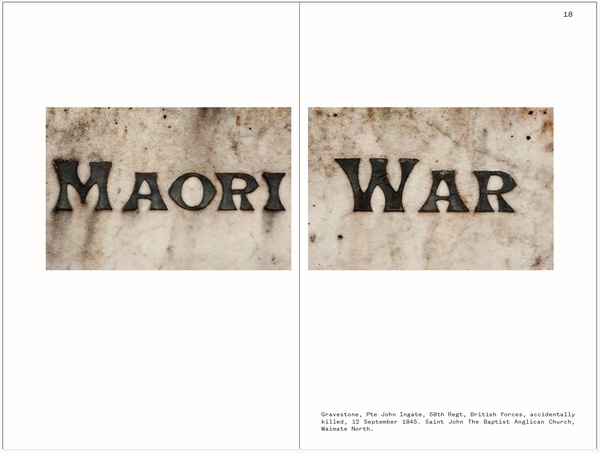
I had a couple of days to wander other sites, and came to the same conclusion. Persevering, I reached the Anglican Waimate North Mission cemetery. I poked around and found various headstones, but the headstone for Pte John Inchgate, 58th Regt of the British forces, who had been accidently killed, gathered my attention.
Across the top of the stone was inscribed in capital letters MAORI WAR. It was unexpected. MAORI WAR? The language of the time, it took my attention. I took some images. I noted to myself: words matter, language is a measure, evidence.
I’ve often found, from an assortment of simmering propositions, one inevitably bubbles to the top to present itself. This was it! The germ of ‘A Vocabulary’.
*********
I had a conversation with Creative New Zealand and was encouraged to apply for funding: for the field work, a book and an exhibition.
As it turned out, CNZ approved only the field work funding, and said I must reapply for the book and exhibition funding after the field work.
I’d never been funded for field work before, it’s always come out of our grocery money. I figured they’d want an outcome, which kept me confident the book and exhibition would materialise. The following year, they funded the post-field work generously, and, after publication of the book, even bought copies for colleagues overseas.
*********
I had sought out Dr Rangihīroa Panoho at an early stage to commission an essay for the book, funding from CNZ. Not an academic or history text, I asked of him, but rather his personal response to the New Zealand Wars. ‘From the heart’, he said.
I explained that I would not read, what is a masterful and affecting essay, until it was bound into the book, his sovereignty over his words.
*********
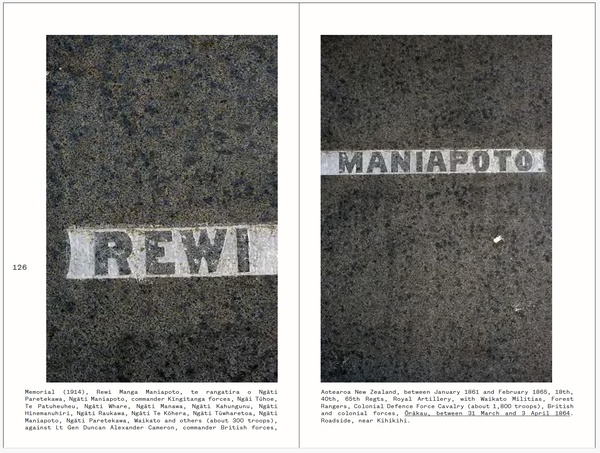
As my concept bedded in, I researched memorials — where they were, which battle or skirmish they represented, when they were erected, what they said, and what they might mean.
I made efficient, regional shot lists as the scope of the project burgeoned, and thought deeply about how to photograph this idea of memorial language as evidence.
I added to the equation a visit years before to the Peggy Guggenheim Museum in Venice. I had wandered into the Mondrian Room, a bedroom once I imagined, where the paintings were so close, so available.
Back in the day, we were raised on famous, unavoidably foreign paintings as images in art books, and Mondrian’s always looked so flat, accurate and strangely architectural. Up close with glasses at Peggy’s, they were anything but. They were rough, irregular, bumpy, as if hurriedly made.
They struck me as raw and profoundly honest. I’m no Mondrian, but that thought, that day, weirdly, helped inform how I might photograph the texts on this project: a little serendipity, a little abstract.
I acquired a second-hand macro lens to be able to photograph closely — a single letter if need be. And I set up protocols. A 35mm camera — not a Burton Bros or Laurence Aberhart or Mark Adams monumental film number, even though I care very much for their work — nimble, a digital camera, no tripod, no lights, a ladder, a ground sheet, and the weather would be what it would be. And Mondrian, of course.
At every memorial, as I climbed from the car or walked towards the monument, I would quietly chant Mondrian, Mondrian, so appropriate synapses would crack into action.
I would be aware of the memorial text’s language, and have considered, in the context of my kaupapa, its particular words and meanings, and how I might deconstruct or reframe them.
But through the camera’s viewfinder, another level always presents itself, concentrating perception, elevating the chance of insight. Intuition. I would experiment in the camera with imagery, investigate, take as many images as necessary — up to 100 sometimes — and trust the later editing process to find the image, or series of images, that would bring some illumination.
The memorials speak, I realised, and how you listen determines what meanings they might offer.
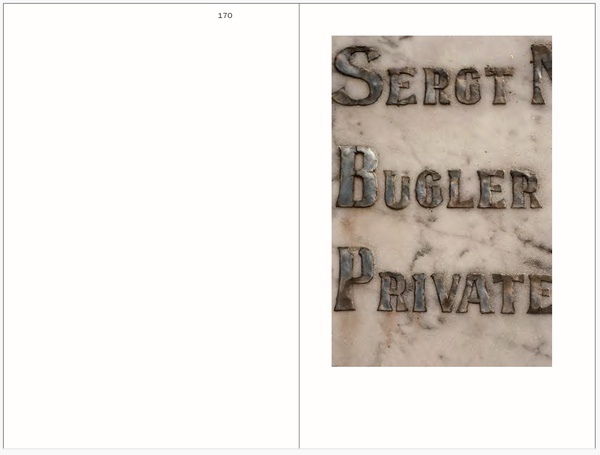
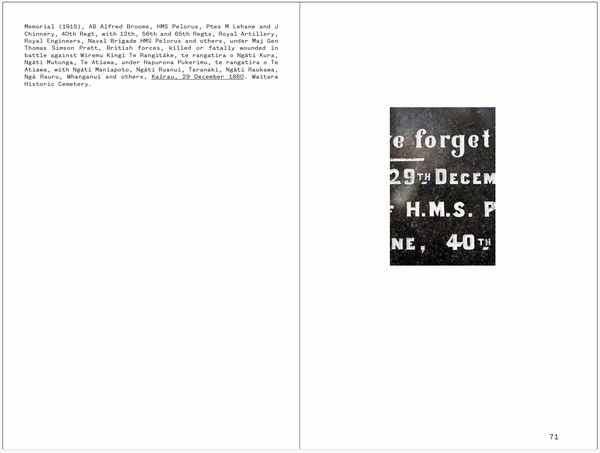
I would work methodically with the camera, horizontally first, old photography habits, to determine words or phrases, perhaps connecting words, or disassociating words, or parts of words, beneath or above a line, adjusting a frame of reference to locate another thrust. Sometimes a single word — ALSO, MEMORY — or a single letter, or punctuation, an ampersand, stylised commas, British and colonial names which became street names, military ranks,
SERGT
BUGLER
PRIVATE
vertically seen, a stack that offered a professional army and premeditation, as did,
HER MAJESTY'S FORCES
from the Alexandra Redoubt, near Tūakau, where I photographed along a long line, one word/one image at a time, as I shuffled right, images inevitably overlapping not concerning myself that they might, “a stuttering poem” as Eye Contact blog’s John Hurrell said in a review.
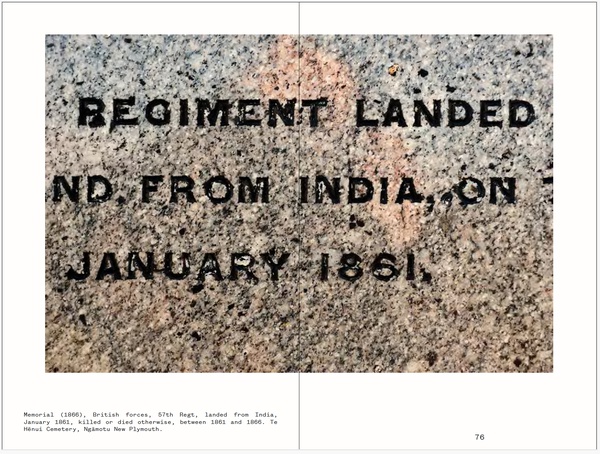
Configured from a memorial text in Ngāmotu New Plymouth to the British Army’s 57th Regt,
REGIMENT LANDED
FROM INDIA, ON
JANUARY 1861,
fundamental information — an army from one British (Raj) colony to a self-governing colony. Again, premeditation, a professional army.
In creating these images, I wanted the lens view to be the final view. No cropping, no Photoshop after the fact to refine images. The Mondrian effect, serendipity, what I saw and recognised at the time.
One of my several compositions from a mottled, marble memorial in Manaia,
TEMPSKY, the name alone, but with three, widowed letters below, the purpose to abstract and concentrate a viewer’s focus, a portrait of surface clues, a compact history.
I took the name SIR GEORGE GREY from the memorial statue in Albert Park, over the road from here — everything is still connected. On a ladder, three images, SIR .. GEORGE .. GREY, the words in upper case, with slightly different sizes in the image, affected by where I could place my ladder — serendipity.
The Empress of India statue is near Sir George Grey in Albert Park.
A week after the exhibition opened at Te Uru Contemporary Gallery in Titirangi, a viewer, Māori, alone in the gallery, walked past the first few process-of-colonisation images,
COOKS VISITS
EMPRESS OF INDIA
POMPALLIER
the WAKEFIELD PLAN plaque in London,
past AUTHOR OF THE SYSTEM OF COLONISATION
MAORI WAR
HEKE’S PAH
and finally reached .. SIR .. GEORGE .. GREY,
a large image work, at which point, he lost his rag (and who could blame him), and screamed, rising to a crescendo, I was told, that he was about to smash the artwork.
The front desk froze, but a curator nearby rushed into the gallery to mediate. She calmed the man down, and then they had kōrero while walking the entire exhibition. There are numbers of triggering images, as I certainly expected.
A friend at the exhibition on opening night became quietly embarrassed and upset, leaving quickly after being confronted with the BRYCE image, a name well-known in her family.
At one institutional gallery on the tour of the ‘A Vocabulary’ exhibition, the kaumātua requested that everyone gather upstairs for his mihi. He walked through the entire show with the evening’s opening crowd in tow like a retinue. Pausing at each artwork, he spoke in te reo, pointed his tokotoko, and spent time knowingly acknowledging the content of the works.
*********
I met a Bulgarian in Paris at an early stage of this project, who was researching her PhD on an heroic Second World War Russian memorial in Sofia, Bulgaria. We discussed this memorial during a broader conversation about the German counter-monument movement. Russia is resolute, Ina told me, that if this memorial is ever disposed of, they will do Bulgaria harm.
She said, at each election, this memorial is targeted by activists who carefully paint the figures as American superheroes — Superman, Ronald McDonald, Santa Claus, American GIs and more. Russia goes nuts, Bulgaria goes nuts, and after the election, the memorial is cleaned, and everything returns to normal.
*********
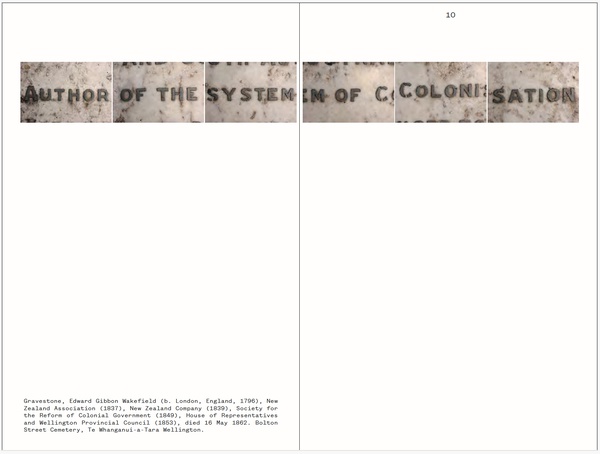
I took my shoes off to walk the horizontal headstones of Edward Gibbon Wakefield, his brother and their respective wives, buried together in Bowen Street Cemetery, not 500 metres from Parliament. We had private kōrero, as I did elsewhere, treading gently above them in my socks.
I busied myself with this particular line,
AUTHOR OF THE SYSTEM OF COLONISATION,
— the business plan — on Edward Gibbon Wakefield’s headstone, one or two words at a time. Shuffling along, unable to keep my hand-held camera exactly straight, I overlapped twice and had the last word colonisation split with the latter half slipping below the first, colonis / sation. It was serendipity, a little abstract, but loaded with meaning, and part of this ‘stuttering poem’.
At St Catherine’s Church in Ōkaihau, I came across a Māori name, a rare event over the 180 memorials, and extracted a sort of, considered short-hand, from this memorial for eleven British soldiers killed in the battle at Puketutu.
HEKE’S PAH, (pā spelt P-A-H)
8TH 1845
GOVT. 1891
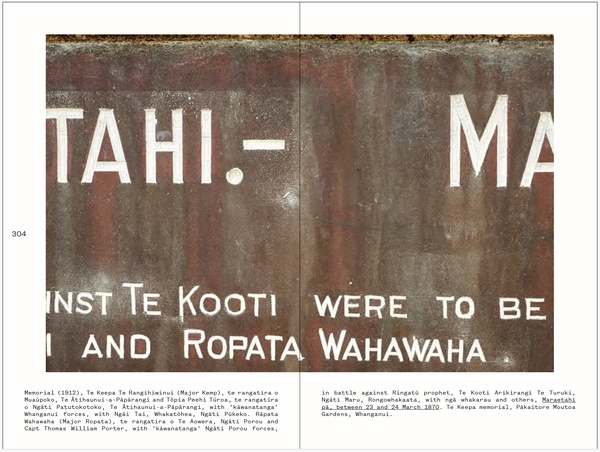
Another time, in Pākaitore, Whanganui, the grand memorial for Te Keepa Te Rangihiwinui, Major Kemp, in the small print at the base of the monument offered,
Te Riwha Tītokowaru
Te Kooti
REBELS
Rāpata Wahawaha
NATIVE CONTINGENT
I found Te Ruki Kawiti’s name on the 1847 HMS Calliope memorial in Bolton Street Cemetery. KAWITI is spelt with two Ts, and CHIEF is spelt C-H-E-I-F, which is chisel-corrected to roughly repair the error.
*********
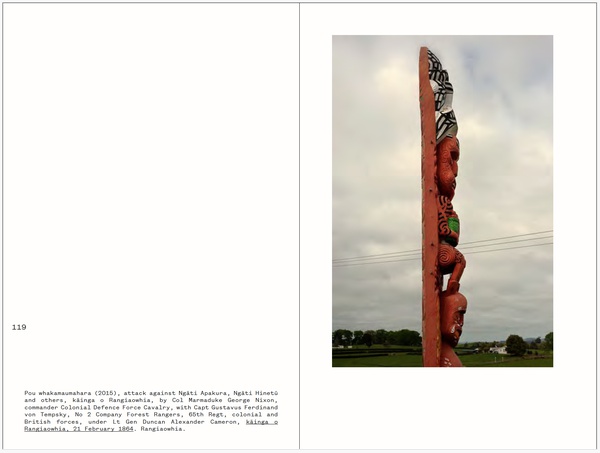
It was only after early forays about Te Ika-a-Maui, and attendant research, that I recognised the memorials to be typically for British and settler colonial soldiers — victors’ memorials. As I noted in my essay at the beginning of ‘A Vocabulary’,
‘On a long drive home one evening, up
against the one-sided face of these primarily
victors’ memorials, I turned them around in
my mind, 180 degrees, and glimpsed a potent
portrait of resistance to dispossession.
Rare are the memorials to that Māori
resistance. More lately, at some sites of
battle, pou whakamaumahara evidence this
Māori narrative.
A brutal dispossession came, no matter
a treaty, the consequences of which abide.’
**********
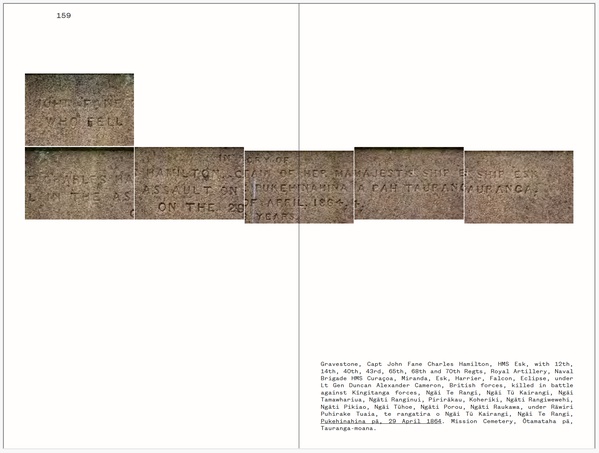
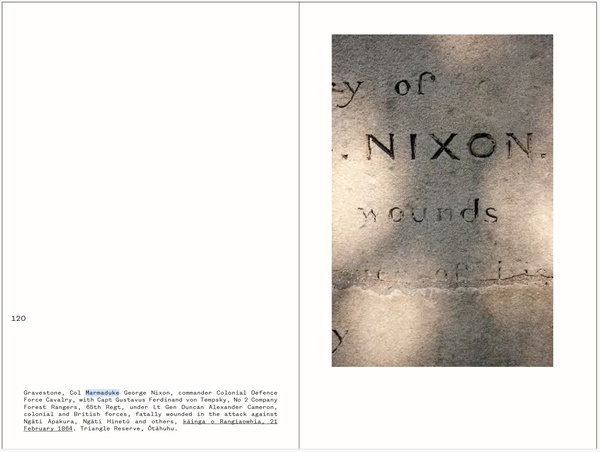
I photographed a number of pou whakamaumahara: two of the sixteen at Rangiriri, two of the eight at Pukehinahina, including one pou of a white-faced Lt Gen Duncan Cameron. More at Te Ranga and one at Rangiaowhia, the Ngāti Apakura tall sentinel surveying confiscated land. This takes me, naturally, to the towering Marmaduke Nixon memorial at the start of the Great South Road, in Otāhuhu — the military road — with his headstone, retrieved from Grafton Gully, at the monument’s base, my three selected lines,
OF
NIXON.
WOUNDS, with a lost ‘y’ bottom left.
*********
I photographed a marble Ngāti Ira memorial in the Waioeka, erected in 2015. I photographed the pointed text horizontally as a three-part joiner image, spanning three vertical lines, reconfiguring to,
NGĀTI IRA TRAGICALLY — THE AND OTHERS SLAUGHTERED — PUNITIVE OF THE CROWN CONFISCATION .. key words.
Key words and names were always important, I would harvest them,
CHATHAM ISLANDS
TE KOOTI
PURSUED,
CONSTABULARY,
vertically seen on a plaque at Ruakituri Cemetery Reserve.
and
SURVEYORS
REDOUBT
HAUHAU
TĪTOKOWARU
[T]ARANAKI
ATTACK,
Again, a compact history vertically seen at Turuturumōkai redoubt.
I photographed the complete text on Cook’s 1920 cairn on Motuara island, Tōtaranui Queen Charlottle Sound, because I was stumped as to which words or lines to pull from such rich pickings,
‘THIS CAIRN WAS ERECTED BY THE CAPTAIN COOK MEMORIAL COMMITTEE TO MARK THE SPOT AT OR NEAR WHICH, ON WEDNESDAY, 31ST JANUARY 1770, THE FAMOUS CIRCUMNAVIGATOR, IN THE PRESENCE OF THE CHIEF OF THE ISLAND, RAISED THE BRITISH FLAG, TOOK POSSESION OF THE MAINLAND IN THE NAME OF KING GEORGE 111, AND NAMED THE INLET QUEEN CHARLOTTE SOUND AFTER THE KING’S CONSORT.
January 31, 1920.’ Another compact history.
*********
As a contemporary aside — a tangent of sorts — my wife, Catherine Griffiths, who made the ‘A Vocabulary’s typography, and helped design both the book and exhibition, is the great-great-grand daughter of Charles Wilson Hursthouse, a recognisable name in this history. Hursthouse had seven children with an English wife, and later another child with Mere Te Rongopamamao Aubrey. This child became Rangimarie Hetet (née Hursthouse), the famed weaver, and mother of Diggeress Te Kanawa.
Catherine has exhibited a glimpse into this whakapapa with an artwork, ‘A whakapapa, two lines of women’, which features Charles Wilson Hursthouse as the common thread, descending five generations from the eldest women on both the Māori and Pākehā sides to the present day. The work concludes where Pākehā Catherine meets her Māori cousin, Te Rongopamamao Robin Bell.
An intricate consequence of colonisation.
In 2020, just before the first Covid-19 lockdown, there was a heart-warming whakakotahi gathering of 150 Māori and Pākehā descendents at Waipātōtō Marae, Ōpārure, near Te Kuiti.
*********
The texts beneath each image ..
I resolved to determine, as correctly as possible, who were the higher-ranking people on both sides of the confrontations, battles, fights and skirmishes represented by the memorials. I wasn’t sure this was possible, but pushed on.
I set up a protocol based on the Washington Post’s (in its better days) Nixon-era Watergate investigations, where the editor required of their reporters, Woodward and Berstein, to have three corroborations of the secret revelations of their confidential source, Deep Throat.
British and colonial names were pretty straightforward, including their spellings, and were well-documented. Māori names at these conflicts proved more difficult to establish, and their spellings too.
If I could not find three separate references to a name, I had a choice to leave it in on probablity, or leave it out. Or call someone.
Chris Pugsley called them an incantation.
*********
We were to print the book in Verona, but in a ‘simple twist of fate’ Italy’s second wave of Covid hit, and we had to face our worst nightmare: to print in Aotearoa. Book printing here relocated to China more than two decades ago because it is less expensive, albeit with a paper and print quality poorer than in Verona. That’s a generation of Aotearoa New Zealand art books.
In Aotearoa, we unexpectedly found the desired quality of production and care, plus some fine discontinued paper stock. But altogether, it cost more than twice as much as in Verona, so the print run was reduced.
*********
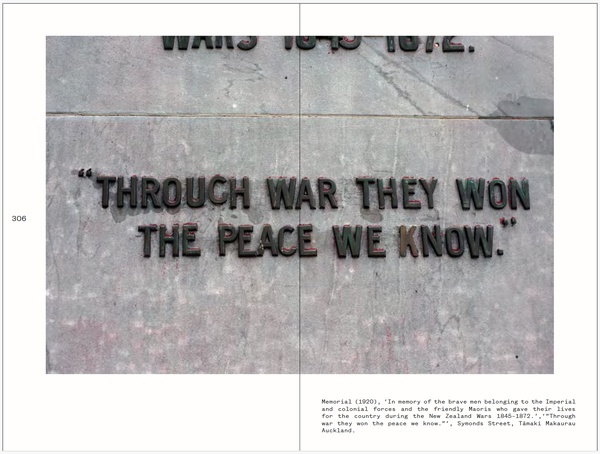
To finish .. the last image in both the book and exhibition is a two-line sentence, an obscene sentiment, on a 1920 Tāmaki Makaurau memorial, on a small, grassy knoll, the Wakefield Street Reserve, in Symonds Street, top of Wakefield Street, opposite Whitaker Place, just up the road.
‘through war they won
the peace we know’
*********
From my ‘A Vocabulary’ introduction,
‘British soldiers typically, colonial
too, settlers, and some Māori who, for one
reason or another, and at different moments,
aligned — and sometimes disconnected —
with the overwhelming military force. And
interlaced with these dead are those who,
replete with political and procedural power,
enabled eager fighters in a contemptuous
plunder of land and vital spirit. These
remnants are scattered across mostly Te
Ika-a-Māui North Island, residual memory,
misremembered, not remembered. And there
are those who know the Imperial story only
too well.’
Evidence. A testimony to be owned.
BRUCE CONNEW / 06.2026